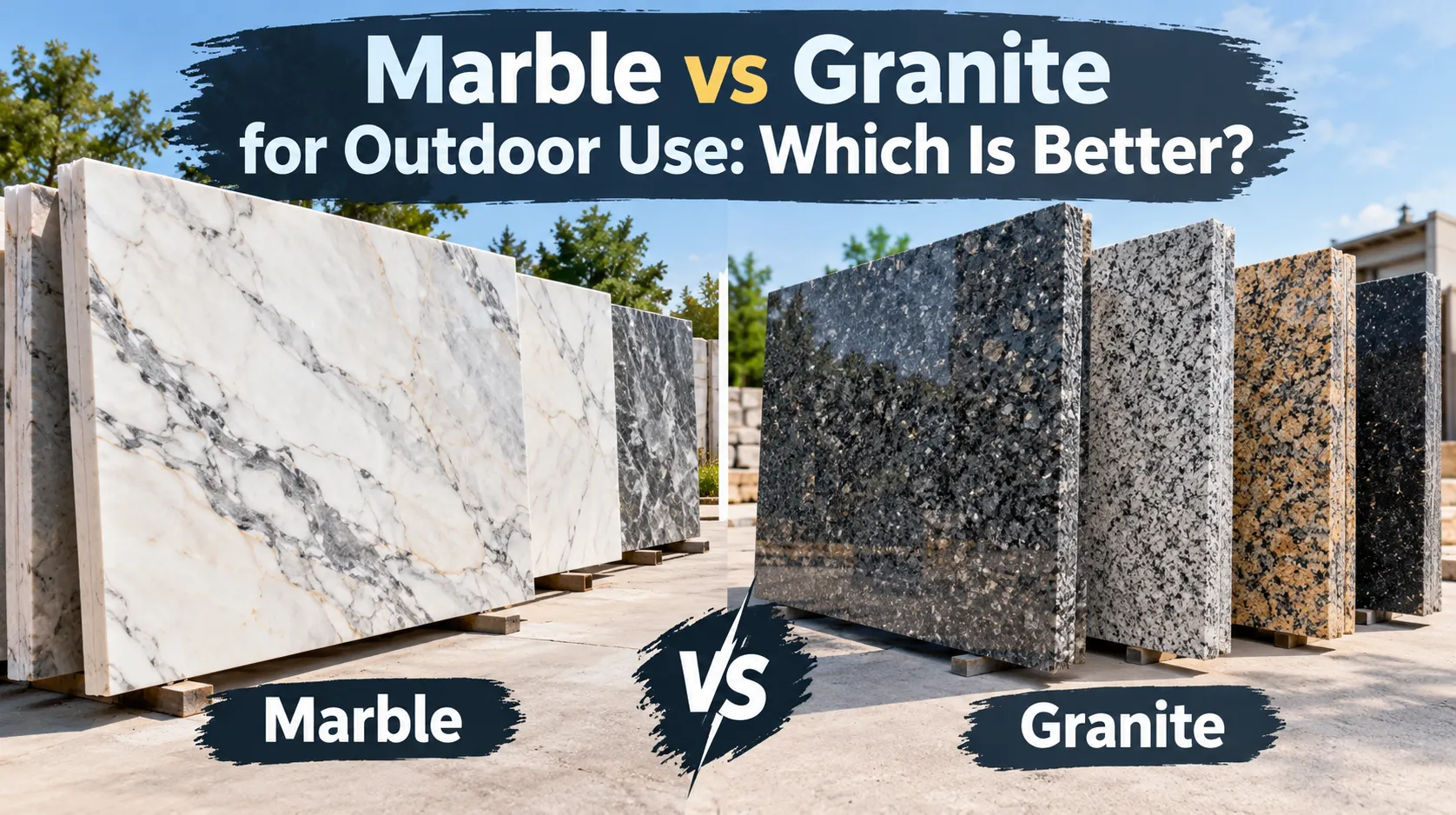
Granite is generally the more practical choice for exposed outdoor paving, busy walkways, and areas subject to frequent wear. Its typical abrasion resistance and weathering performance make it a strong candidate for demanding exterior projects. Marble can also be used outdoors, particularly for selected facades, architectural details, and appropriately specified paving, but its susceptibility to acids and surface wear calls for more careful selection.
The better stone is not determined by its name alone. Climate, exposure, finish, slab dimensions, installation, and the test results for the actual material being supplied all matter. This guide compares marble and granite for common outdoor applications and explains what to verify before ordering.
Marble vs Granite for Outdoor Use: Quick Comparison
| Selection factor | Granite | Marble |
|---|---|---|
| Geological composition | Primarily silicate minerals, commonly including quartz and feldspar | Commonly calcite or dolomite, depending on the variety |
| Abrasion and scratching | Generally more resistant to wear | Generally more vulnerable to scratches and surface wear |
| Acid sensitivity | Typically less sensitive to everyday mild acids, though chemical compatibility still matters | Calcite-rich varieties can etch when exposed to acids |
| Moisture and freeze–thaw | Often a strong candidate; verify absorption and freeze–thaw suitability | Performance varies significantly by variety; testing is especially important for exposed use |
| Sunlight and weathering | Generally good outdoor weathering performance | Appearance can change through weathering, pollution, and acid exposure |
| Slip resistance | Depends on the selected finish and tested installed surface | Depends on the selected finish and tested installed surface |
| Maintenance | Often relatively straightforward | Usually requires greater attention to staining, etching, and finish changes |
| Common exterior uses | Patios, steps, pathways, kerbs, cladding | Selected cladding, architectural features, and tested or protected paving |
Bottom line: For a busy, uncovered patio, granite is often the lower-risk starting point. For a decorative facade, marble may be appropriate and visually compelling. Neither material should be approved for a project without checking the specific stone’s technical data and installation conditions.
Why Marble and Granite Perform Differently Outdoors
Granite is an igneous rock composed predominantly of silicate minerals. It is commonly valued for its strength, abrasion resistance, and long-standing use in exterior paving and cladding. Marble is a metamorphic stone formed through the recrystallization of carbonate-rich rocks. Many marbles contain calcite, which reacts with acids and can gradually lose a polished appearance in exposed conditions.
These geological differences are useful starting points, not guarantees for every slab. Mineral composition, natural fissures, fabrication, and quarry-to-quarry variation influence performance. Commercial stone names also do not always align perfectly with strict geological classifications. Ask suppliers for data tied to the specific product and quarry rather than relying on a generic claim about “granite” or “marble.”
Water Absorption Is Not the Same as Porosity
Porosity refers to the proportion of void space within a material; water absorption measures the amount of water a specimen takes up under defined test conditions. They are related but should not be used interchangeably. A commonly referenced method for dimension stone is ASTM C97/C97M, which determines absorption and bulk specific gravity.
Low water absorption can be advantageous outdoors, but a single absorption figure does not prove that a stone will survive every freeze–thaw environment. The arrangement of pores, the presence of flaws, repeated saturation, and the details of the installation also influence durability. Request the tested value for the particular stone, along with any exposure-specific durability evidence required for the project.
Abrasion Resistance and Acid Etching
For heavily used outdoor steps and walkways, resistance to wear is important. Granite will commonly outperform calcite-rich marble in abrasive environments, especially when surfaces encounter shoes, grit, and movable furniture. Yet the finish and its expected wear pattern should also be evaluated.
Marble has a separate vulnerability: acid etching. Rainfall affected by air pollution, acidic food spills, and unsuitable cleaning agents can alter the finish of calcite-rich marble. An impregnating sealer may improve resistance to staining, but it does not make marble acid-proof. Granite is generally less vulnerable to these everyday acid exposures, although harsh chemicals can damage certain minerals, coatings, or adjacent installation materials.
Which Stone Is Best for Each Outdoor Application?
Patios, Walkways, and Outdoor Steps
Granite is usually the first material worth evaluating for a patio or heavily used path because of its abrasion resistance and established exterior applications. Choose a surface texture suited to wet-foot traffic and confirm the required slip performance. A polished sample may look attractive indoors but may not offer sufficient traction on an exposed walkway.
For stone selections from Pars Stone, compare Green Granite and Natanz Black Granite as possible candidates for exterior walkways. Khoramdareh Granite and White Granite are additional options to evaluate where their tested properties, available finishes, and project requirements align. These are candidates for specification, not claims of certified slip resistance or freeze–thaw performance.
Marble is not automatically unsuitable. Some varieties and finishes can perform in appropriate exterior conditions, especially in sheltered or lower-traffic areas. However, the project should account for increased wear, possible surface etching, and the appearance changes that can occur over time.
For steps and paving, also specify suitable thickness, support, joints, movement accommodation, and drainage. The most durable stone can still fail if the paving system traps water or lacks adequate support.
Pool Decks and Pool Coping
For pool surrounds, slip resistance and a sound installation system matter more than a blanket claim that one stone is “non-slip.” A textured granite may be a practical choice, but the selected finish should be assessed for barefoot comfort and slip behavior under the relevant wet conditions.
Where a textured finish is preferred, Bush Hammered Finish or Sandblasted Finish may be worth discussing for compatible stone products. Do not assume either finish guarantees safety around a pool without relevant wet and barefoot slip testing.
Marble can be considered for selected pool applications, but its exposure to moisture, cleaning chemicals, and abrasion deserves careful review. Chlorine and pool-treatment products should not be treated as chemically harmless to every natural stone or installation component. The material, finish, sealant, grout, and cleaning regime all require compatibility checks.
Ask the supplier or project designer for relevant test results and review drainage, edge details, and maintenance instructions before purchase.
Exterior Walls and Facades
Both granite and properly selected marble can be used for exterior architectural cladding. Granite is often chosen for durability and relatively straightforward long-term appearance management. Marble offers distinctive veining and a refined visual character, but certain varieties can experience significant weathering and surface changes.
For a more decorative exterior appearance, Pietra Gray Marble, White Marble, and Double Black Semi-granit can be considered as visual options, subject to product-specific exterior suitability. A Rock Face Finishing treatment can provide pronounced texture for a feature wall where appropriate for the chosen material and facade system.
On facades, the stone’s flexural properties, dimensions, fixing system, anchorage, and environmental exposure are critical. Do not select an exterior cladding slab based solely on color, thickness, or a showroom sample. Stone-specific engineering and facade design should guide the specification, especially for large panels and high buildings.
Outdoor Kitchens and Countertops
Granite is generally the more forgiving option for outdoor food-preparation counters, because calcite-rich marble can etch in contact with lemon juice, vinegar, and other acids. Even granite should be cleaned with products appropriate to natural stone, and its exact composition and finish should be checked.
For a dark countertop aesthetic, Black Granite or Natanz Black Granite may be relevant selections to review; confirm the available finish, fabrication details, and outdoor suitability before specifying either one.
For marble counters, an owner must be comfortable with visible wear and patina or be prepared for more careful use and maintenance. Neither surface should be assumed to be maintenance-free.
How Climate Changes the Decision
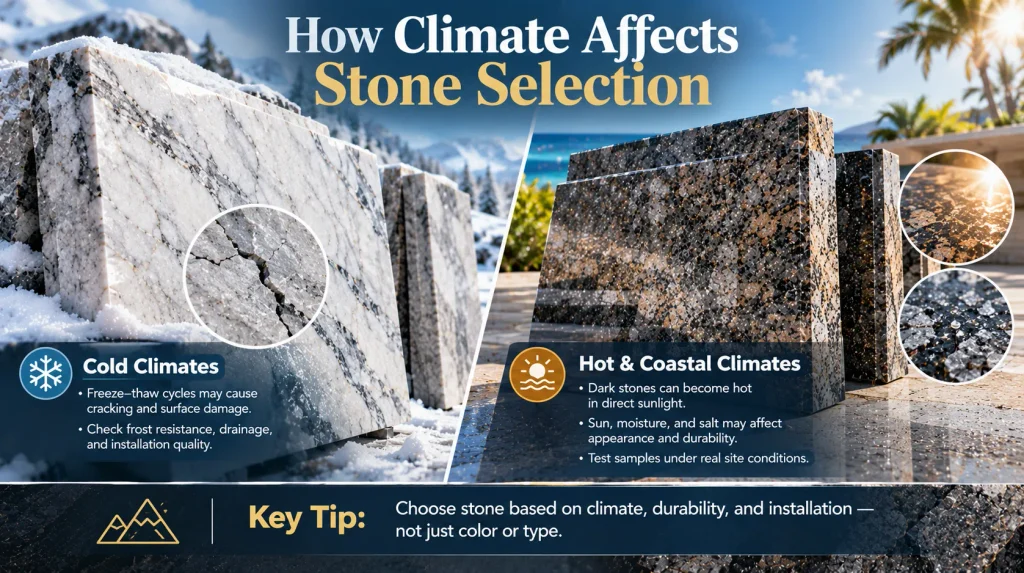
Cold Climates and Freeze–Thaw Exposure
When moisture enters a stone or an installation system and freezes, repeated expansion can contribute to cracking, scaling, or detachment. Granite often offers favorable performance, but low water absorption alone cannot guarantee frost resistance. Marble performance varies by variety and should never be judged solely by its geological category.
For freeze-prone sites, prioritize stone-specific durability information, appropriate installation materials, controlled water movement, drainage, and details that prevent prolonged saturation. Avoid generic promises that any marble will fail within a set number of winters or that every granite is frost-proof.
Hot, Sunny, and Coastal Sites
Natural stone often performs well under sunlight, but appearance and thermal comfort depend on several factors. Dark surfaces may become uncomfortable in direct sun regardless of whether the stone is marble or granite. Some stones can show changes caused by weathering, surface treatments, mineral oxidation, or prolonged exposure.
In coastal conditions, review salt exposure, moisture movement, cleaning methods, and the corrosion resistance of any metal fixings. For barefoot terraces, test representative samples in the conditions users will actually encounter instead of selecting solely by color or stone family.
Surface Finishes: Safety and Appearance
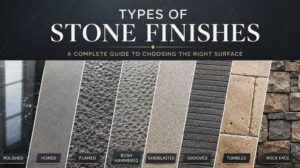
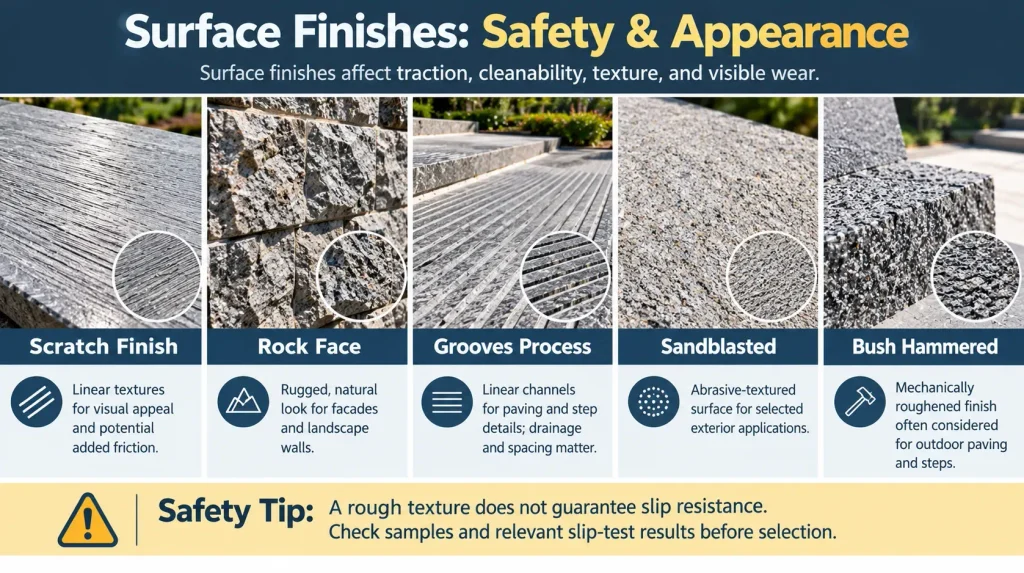
A finish influences traction, cleanability, texture, and the visibility of wear. Pars Stone offers several processing options worth comparing for exterior architectural projects:
- Scratch Finish: Deliberately scored textures for visual interest and, in some configurations, added surface friction. The direction and depth of scratches influence how the surface behaves and should be assessed with a sample.
- Rock Face Finishing: A rugged, cleft-like appearance particularly relevant to decorative facades, landscape walls, and architectural features; it is not automatically appropriate for walking surfaces.
- Grooves Process: Cut linear channels useful for visual definition and certain step or paving details. Their spacing, orientation, and drainage context should be designed carefully; grooves alone do not prove slip resistance.
- Sandblasted Finish: An abrasive textured treatment that may be considered for suitably specified exterior surfaces. Request a representative sample and relevant slip test results.
- Bush Hammered Finish: A mechanically roughened finish often considered for outdoor paving and steps, with final suitability determined by surface testing and the chosen stone.
For instance, the existing Pars Stone catalog includes a Natanz Black Granite Scratch Finish product and a Brushed Bush Hammered Grooved Green Granite product. These establish that particular stone–finish combinations are offered, but they do not establish project suitability without data.
Do not treat a finish name as a substitute for testing. Slip resistance depends on surface microtexture, contamination, footwear or barefoot use, water, and the relevant testing protocol. Ask the project professional which method and performance requirement apply in the destination market.
Technical Tests to Request Before Buying Outdoor Stone
Professional buyers should compare actual product test reports, not marketing descriptions. Depending on the application and jurisdiction, useful information can include:
| Test or document | What it helps assess | Why it matters |
|---|---|---|
| ASTM C97/C97M | Water absorption and bulk specific gravity | Useful for understanding moisture uptake; not a standalone frost-resistance approval |
| ASTM C880/C880M | Flexural strength | Particularly relevant to bending stresses in dimension-stone design |
| ASTM C99/C99M | Modulus of rupture | Additional bending-related data used in certain stone specifications |
| ASTM C241/C241M or ASTM C1353/C1353M, as applicable | Abrasion resistance | Helps evaluate stone intended for wearing surfaces |
| Project-appropriate slip testing | Surface traction under defined test conditions | Important for stairs, walkways, and pool surrounds |
| Project-specific frost/durability evidence | Suitability for repeated exposure | Essential where freeze–thaw performance is a design concern |
| Approved finish sample and installation details | Appearance, workmanship, assembly performance | Helps match the delivered product to intended use |
These tests describe different characteristics; one report cannot replace another. Applicable standards and required values vary with product type, national regulations, and the design specification. Have the project architect or engineer define acceptance criteria before placing a bulk order.
Maintenance and Long-Term Ownership Costs
Both stones benefit from regular removal of grit and organic debris, timely cleaning of spills, and appropriate water management. The Natural Stone Institute recommends cleaning natural stone with suitable neutral products and notes that impregnating sealers improve stain resistance rather than making stone stain-proof.
For granite, maintenance may be relatively light, but requirements depend on the stone’s finish, exposure, staining tendency, and installation. Avoid assuming that high-pressure washing or acidic chemicals are harmless; always follow the stone and cleaning-product supplier’s guidance.
For marble, use non-acidic cleaning products and accept that exposed calcite-rich finishes may develop etching or patina over time. Sealer reapplication should be based on the selected product, use conditions, and performance checks—not an automatic rule of once or twice per year. Sealing also does not prevent acid etching.
When comparing costs, evaluate more than the price per square meter: fabrication, thickness, transport, installation, slip-resistant finishing, periodic care, and the potential need for restoration all affect the full project cost.
How to Choose the Right Stone: A Practical Buyer Checklist
Before approving an outdoor order, confirm the following:
- Application: Is the stone for paving, stairs, pool coping, an outdoor worktop, or facade cladding?
- Exposure: Will it face frost, heavy rain, salt, pollution, direct sun, or frequent wet use?
- Specific material: What is the quarry source, commercial name, mineral composition, and batch consistency?
- Testing: Are current, relevant reports available for the stone being supplied?
- Finish: Is a representative sample available, and does its slip performance suit the location?
- Installation: Have the designer and contractor specified appropriate thickness, drainage, joints, fixings, and substrate conditions?
- Ownership: Is the owner willing to maintain the material and accept its natural weathering characteristics?
A material that checks all seven boxes is a better investment than one chosen only because it belongs to a supposedly “stronger” category.
Sourcing Marble and Granite from Iran
Iran supplies a broad variety of natural stones with distinctive colors and appearances. For international projects, sourcing decisions should be based on verified specifications, finish consistency, sample approval, packaging, and the destination project’s technical requirements, rather than country of origin alone.
If you are comparing materials for an exterior project, explore the available options when you buy stone from Iran. Pars Stone offers dark and light marble selections alongside several granite options, as well as textured processing methods for different design requirements. Ask for the exact stone name, available finishes and dimensions, and any relevant product test documents before finalizing a specification. A supplier can help identify suitable candidates; the designer or engineer should confirm their fitness for the intended application.
Final Verdict: Choose by Application, Then Verify the Stone
For exposed pathways, busy patios, and many outdoor working surfaces, granite is generally the stronger starting recommendation. For selected facades, decorative features, and carefully specified projects, marble can be an appropriate choice. The real decision depends on exposure, finish, required performance, maintenance expectations, and verified data for the stone you intend to buy.
Before placing an order, compare samples and technical information for the exact materials under consideration. That approach is more reliable than relying on broad promises about any stone’s lifetime performance.
Technical References
- Natural Stone Institute — Granite: technical overview and exterior applications.
- Natural Stone Institute — Marble: technical overview and exterior-weathering considerations.
- Natural Stone Institute — Care & Cleaning of Natural Stone.
- Natural Stone Institute — Dimension Stone Design Manual and stone testing resources.
Editorial note: The comparisons above are general selection guidance, not certification of any specific Pars Stone product. Do not insert numerical product performance claims or approval language until matching technical reports have been checked. Confirm live product/category URLs before adding more internal links.
Frequently Asked Questions
Is granite better than marble for outdoor patios?
Usually, granite is the more practical starting point for high-traffic, exposed patios because of its typical abrasion resistance and weathering performance. Still, the selected granite must have a suitable finish, relevant test data, and a sound installation design.
Can marble be used outside in cold weather?
Yes, certain marbles may be suitable for specific exterior applications in cold climates, but selection must be based on the particular stone’s properties, relevant durability evidence, and installation design. It is inaccurate to assume that every marble will fail—or that every granite will survive—freeze–thaw conditions.
Which stone is safer around a swimming pool?
Neither material is automatically slip-resistant. Safety depends on the surface finish, measured slip performance under relevant wet conditions, drainage, and maintenance. Textured granite is often considered, but it still needs project-specific evaluation.
Does outdoor marble always need sealing?
No universal sealing schedule applies to every marble. A suitable impregnating product may reduce staining, but requirements depend on the stone, finish, and use conditions. Sealing does not stop acid etching.
Does granite fade in sunlight?
Many natural granites offer strong exterior color stability, but the behavior of individual minerals, resins, coatings, and surface treatments varies. Request a representative sample and discuss the specific product’s outdoor history where appearance consistency is critical.
What is the most important document to request from a stone supplier?
There is no single test that proves suitability for every outdoor use. Request a relevant stone-specific technical package, including moisture, strength, abrasion, or slip data as required by the application, along with the proposed finish and installation specification.