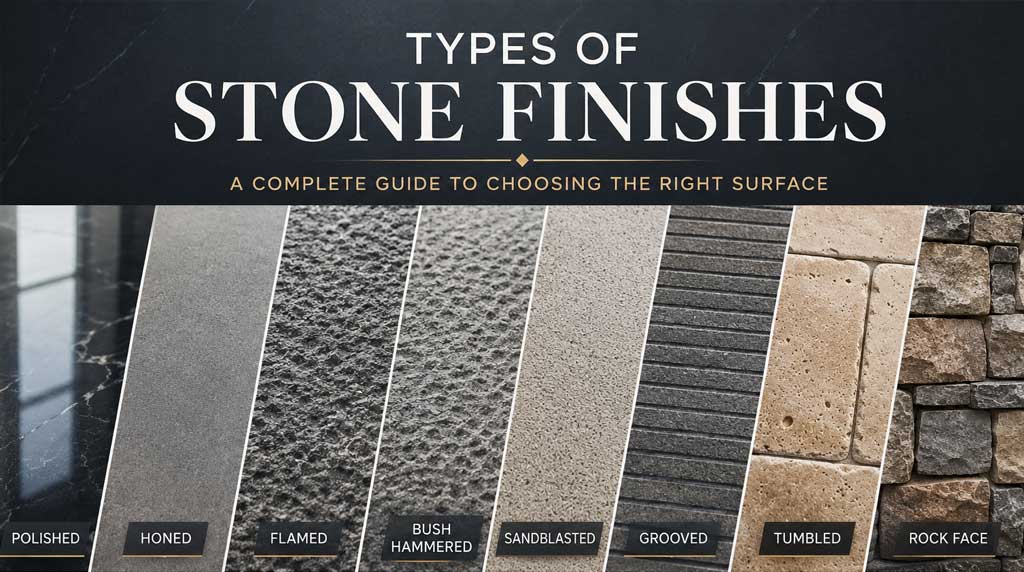
Natural stone can be shaped into dozens of different surface textures, and each one changes how the material looks, feels, and performs. If you’re trying to understand the main types of stone finishes before starting a project, here’s the short answer: the most common options are polished, honed, flamed, brushed, bush-hammered, sandblasted, tumbled, leathered, split-face, rock-faced, sawn-cut, acid-washed, and grooved or scratch finishes — each suited to different rooms, climates, and levels of foot traffic.
Keep reading below for a detailed breakdown of every finish, grouped by how they behave and where they work best, plus a comparison table and answers to the questions people ask most.
What Are Stone Finishes and Why They Matter
A stone finish is the surface treatment applied to a slab or tile after it’s been cut from the quarry. The same block of marble or granite can look completely different depending on the finishing method used — from a glassy, reflective polish to a rugged, weathered texture. Beyond looks, the finish also affects slip resistance, dirt absorption, maintenance requirements, and how well the stone holds up outdoors versus indoors.
A quick note on slip resistance, since several finishes below claim to be “non-slip”: the industry benchmark most manufacturers and installers reference is the DCOF (Dynamic Coefficient of Friction) rating, with a wet DCOF of 0.42 or higher generally recommended for level interior floors under ANSI A137.1. It’s worth asking any supplier for the tested DCOF value of a specific finish rather than relying on the word “textured” alone.
Understanding the different types of stone finishes is the first step toward choosing a surface that matches both your design vision and the practical demands of the space.
Group 1: Smooth and Reflective Finishes
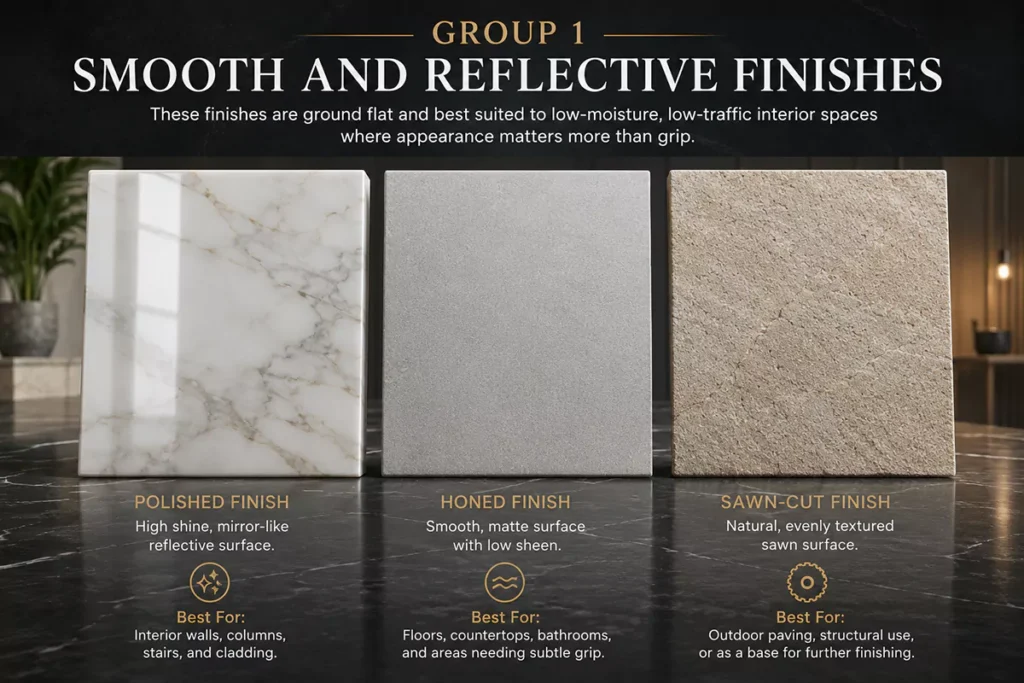
These finishes are ground flat and are best suited to low-moisture, low-traffic interior spaces where appearance matters more than grip.
Polished Finish
Polished stone is created by mechanically grinding and buffing the surface until it develops a smooth, mirror-like shine and strong light reflection. Nearly every type of natural stone can be polished, though the degree of shine varies depending on the stone’s mineral composition. This finish is prized for showcasing a stone’s natural color and veining in full detail, making it a favorite for interior and exterior walls, columns, staircases, and hallway cladding.
Because polished surfaces are smooth, they can become slippery when wet (typically falling well below the 0.42 wet-DCOF benchmark), so they’re generally not recommended for flooring in bathrooms, staircases, or other areas prone to moisture. The surface is also more prone to visible scratches than textured finishes, and small pores are typically filled with resin or epoxy during processing — it’s worth confirming this filling is even and won’t discolor or react to sunlight or acidic substances over time. For wet or high-traffic areas, see the Honed Finish below, or the anti-slip options in Group 2.
(Suggested image: polished marble slab under studio lighting, alt text: “polished marble slab showing mirror-like reflective finish”)
Honed Finish
Honing produces a smooth, flat surface with a soft, matte appearance — essentially the same grinding process as polishing, but stopped before the final buffing stage that creates shine. This gives the stone a more understated, contemporary look while hiding scratches, etching, and minor wear far better than a polished surface. Honed finishes are especially popular for marble and limestone flooring, kitchen countertops, and bathroom surfaces, where a soft, non-reflective look is preferred and moderate slip resistance is more important than shine.
Sawn-Cut Finish
A sawn-cut finish is the most basic surface treatment — essentially the flat, slightly textured surface left behind after a stone is cut with a saw, before any additional processing is applied. It has a semi-rough, consistent texture that offers reasonable slip resistance without the cost of further finishing. Sawn-cut stone is often used as a budget-friendly option for garden paving and structural applications, or as a base layer before a decorative finish like flaming or bush-hammering is applied.
Group 2: Textured and Slip-Resistant Finishes
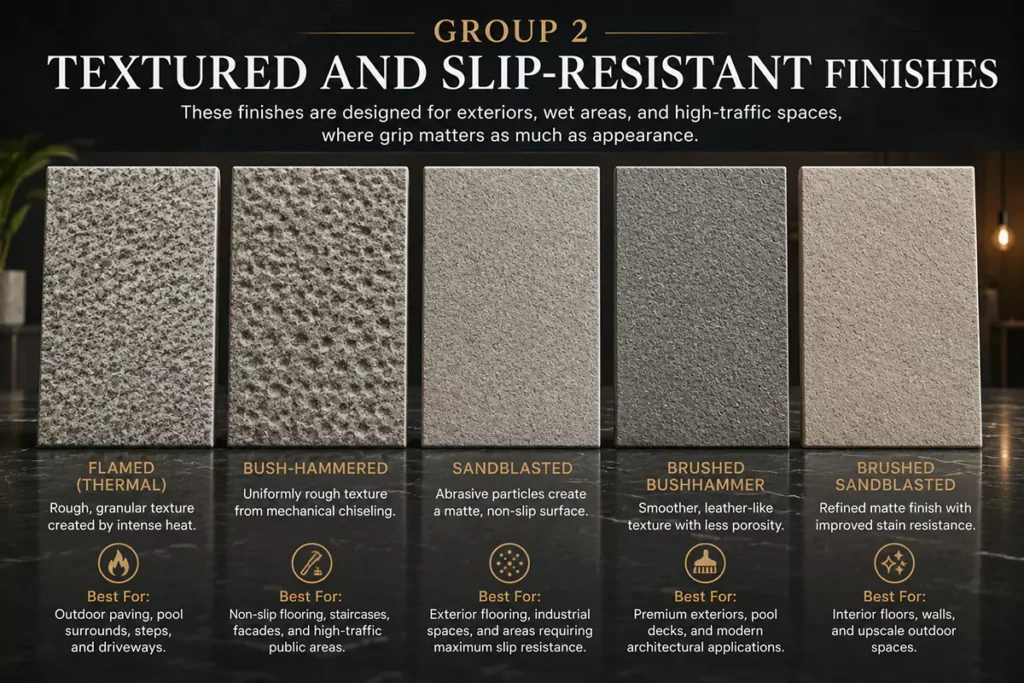
These finishes are designed for exteriors, wet areas, and high-traffic spaces, where grip matters as much as appearance.
Flamed (Thermal) Finish
A flamed, or thermal, finish is created by passing an intense flame over the stone’s surface, causing the outer crystals to fracture and pop, leaving behind a rough, matte, highly textured surface. This process works best on granite and other coarse-grained stones, since the technique relies on differing mineral expansion rates to create texture. Because it produces strong slip resistance even in wet conditions, flamed stone is a go-to choice for outdoor paving, pool surrounds, steps, and driveways.
Bush-Hammered and Brushed Bushhammer Finish
Bush hammered finishing uses a mechanical tool fitted with rotating, needle-like heads that strike the stone’s surface, creating a uniformly rough, slip-resistant texture. It’s typically applied to dense stones such as granite, marble, and travertine, and is especially valued for its anti-slip performance, scratch resistance, and matte appearance that reduces glare in sunny outdoor spaces.
A more refined variation, Brushed Bushhammer, softens the rough bush-hammered surface into a smoother, leather-like texture (similar in feel to the Leathered Finish). This finish resists dirt and stains far better than standard bush-hammering, cleans easily with a damp cloth, and holds its appearance over time without needing wax or nano-coating. Bush hammer stone finish options are used for non-slip flooring, textured facades, staircases, and high-traffic public spaces such as parks, entrances, and poolside areas.
Sandblasted and Brushed Sandblasted Finish
Sandblasting works by spraying abrasive particles — typically sand or silica — onto the stone’s surface under pressure, creating shallow pits and grooves that produce a rough, matte, non-slip texture. It’s one of the most widely used finishes for outdoor and industrial applications because of its grip and durability, though the increased porosity means it can absorb more dirt over time.
Brushed sandblasting adds a refinement step after the initial sandblasting process, softening the texture into a smoother, more matte finish with reduced porosity. This makes it easier to clean, more resistant to staining, and better suited to interior floors, decorative walls, and upscale outdoor spaces. Choosing between standard and brushed sandblasted stone comes down to whether the priority is maximum grip in a functional space or a refined, low-maintenance surface for a more polished environment.
Grooved Finish
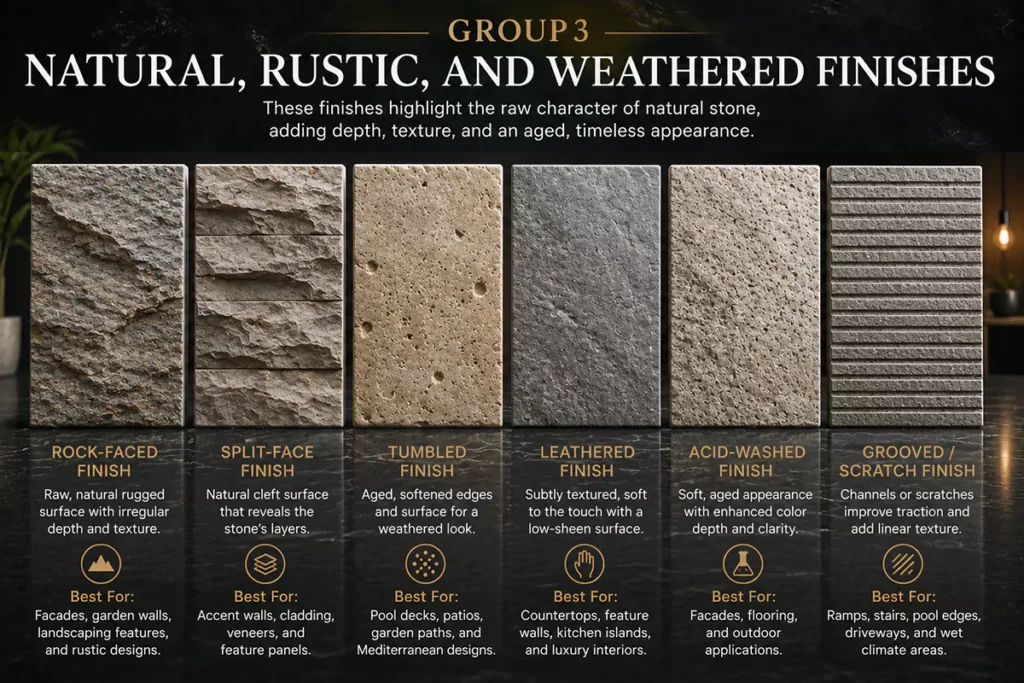
The grooved finish process carves precise, evenly spaced channels into the stone’s surface using specialized machinery. Beyond its striking linear appearance, this finish significantly improves water drainage and traction, making it a practical choice for ramps, staircases, poolside decks, and driveways in regions with rain, snow, or ice.
Several popular variations fall under this category: Autoban (straight, evenly spaced grooves), Double Line (paired grooves set close together), Frame Line (multiple grooves grouped with wider spacing between sets), Injent (grooves with smooth, leathered edges), and Cut Hammer, which combines grooves with an antique, weathered texture. Installed horizontally, grooved stone can make a space feel more spacious; installed vertically, it visually elongates walls and facades.
Scratch and Leather Scratch Finish
Scratch finishing creates deliberate grooves or fine lines across the stone’s surface, either in an organized pattern or a more random, artistic arrangement. It can be applied to both polished and unpolished stones, and is increasingly combined with sandblasted or leathered surfaces to create hybrid textures.
The Leather Scratch variation pairs the textured look of scratching with the softness of a leathered surface, producing a finish that resists slipping and sheds dirt more easily than a standard scratch finish. Other popular sub-types include Wide Scratch (bolder, more widely spaced lines for exterior cladding and large-scale features) and Needle Scratch (a finer, more delicate pattern suited to luxury interiors). Scratch finish stone is commonly used on countertops, staircases, feature walls, and both interior and exterior cladding.
Group 3: Natural, Rustic, and Weathered Finishes
These finishes lean into stone’s raw character rather than smoothing it away, and suit rustic, traditional, or architecturally dramatic designs.
Rock-Faced Finish
Rock face finishing (or rock faced) is designed to highlight the raw, natural ruggedness of stone rather than smooth it away. The process starts with careful selection of durable stones, followed by tumbling to soften the edges and create an irregular, weathered surface. In some cases, acid washing is used afterward to deepen or brighten the stone’s natural color. The result is a textured, uneven surface with variable thickness that gives every piece a distinct, one-of-a-kind character.
Because it preserves the stone’s structural integrity while enhancing its resistance to weather and heavy use, rock face stone is a popular choice for facades, garden pathways, decorative accent walls, and landscaping features.
Split-Face (Natural Cleft) Finish
Split-face finishing is used on stones that naturally form in layers, such as slate and sandstone. The stone is cleaved along its natural bedding plane rather than being mechanically ground, leaving an irregular, three-dimensional surface with pronounced texture and depth. This finish is almost exclusively used for accent walls, cladding, and veneer applications where a raw, dramatic, dimensional look is the goal rather than a flat, uniform surface.
Tumbled Finish
Tumbling places small stone tiles or pavers into a rotating drum along with abrasive materials like sand, gravel, or smaller stones, wearing down the edges and surface to mimic the look of naturally aged, weathered stone. This finish is especially popular for travertine and limestone, giving tiles rounded edges and a soft, rustic texture. Tumbled stone is a common choice for Mediterranean and traditional interiors, garden paths, and pool decks.
Brushed Finish
Brushing uses wire wheels or abrasive brushes to gently wear down the stone’s surface, softening its edges and creating a texture that feels smooth to the touch while still showing subtle relief. The result is a slightly worn, antiqued look that sits between a honed and a leathered finish in terms of texture. It’s a versatile option for floors and walls where a casual, lived-in aesthetic is desired without the deeper texture of tumbling or bush-hammering.
Leathered Finish
A leathered finish is achieved by brushing the stone’s honed surface with diamond-tipped brushes, creating a subtly textured, low-sheen surface that feels almost like leather to the touch. It enhances the stone’s natural color and pattern while hiding fingerprints, water spots, and minor scratches far better than a polished surface. Leathered stone has become a favorite for kitchen islands, countertops, and statement walls.
Acid-Washed Finish
Acid washing involves treating the stone’s surface with a mild acidic solution that reacts with the material to create a soft, slightly textured, aged appearance while also removing residual impurities. This technique can intensify the stone’s natural color — brightening lighter stones and deepening the tone of darker ones — and is often used in combination with other finishes, such as rock-facing, to enhance color depth and authenticity. Acid-washed stone works well for facades, flooring, and outdoor applications where a naturally weathered, understated look is desired.
Comparison Table: Which Finish Fits Your Project?
| Finish | Best For | Slip Resistance | Maintenance |
|---|---|---|---|
| Polished | Interior walls, columns, low-traffic floors | Low (avoid wet areas) | High — shows scratches, needs sealing |
| Honed | Kitchen/bath counters, marble & limestone floors | Moderate | Moderate |
| Flamed | Outdoor paving, pool surrounds, driveways | High | Low |
| Bush-Hammered | Non-slip flooring, staircases, public spaces | High | Low |
| Brushed Bushhammer | Facades, poolside areas | High | Low |
| Sandblasted | Outdoor/industrial floors, exteriors | High | Moderate (porous) |
| Brushed Sandblasted | Interior floors, decorative walls | Moderate–High | Low |
| Grooved | Ramps, staircases, driveways in rain/snow | High | Low |
| Scratch | Countertops, feature walls, cladding | Moderate | Moderate |
| Rock-Faced | Facades, pathways, accent walls | High | Low |
| Split-Face | Accent walls, cladding, veneer | High | Low |
| Tumbled | Garden paths, pool decks, rustic interiors | Moderate–High | Low |
| Brushed | Floors and walls, lived-in aesthetic | Moderate | Low |
| Leathered | Kitchen islands, countertops | Moderate | Low |
| Sawn-Cut | Budget paving, structural base layer | Moderate | Low |
| Acid-Washed | Facades, outdoor flooring | Moderate | Low |
Slip resistance is described qualitatively here; always request the tested wet-DCOF value for the specific stone and finish before specifying it for a floor.
How to Choose the Right Stone Finish for Your Project
With so many types of stone finishes available, the right choice depends on a few key factors:
- Location: Exterior and wet areas call for textured, slip-resistant finishes like flamed, bush-hammered, sandblasted, or grooved surfaces (see Group 2). Interior walls and low-traffic areas can safely use polished or leathered finishes.
- Maintenance: Smoother finishes like polished and honed stone show scratches and etching more easily, while leathered, brushed, and bush-hammered surfaces hide daily wear better.
- Stone type: Not every stone accepts every finish — softer stones like marble have more limitations than dense granites, so it’s worth confirming compatibility before choosing.
- Design goal: Rock-faced, split-face, and tumbled finishes suit rustic or natural aesthetics (Group 3), while polished and honed surfaces lean toward sleek, modern interiors (Group 1).
Conclusion
From the mirror-like shine of a polished surface to the rugged texture of rock-faced and bush-hammered stone, each of these finishes offers a distinct combination of appearance, durability, and practicality. Matching the right finish to your project’s location, traffic level, and design style will ensure the stone performs well and looks its best for years to come.
Pars Stone Factory produces a full range of these finishes — including rock face, bush hammer, sandblasted, grooved, and scratch finishes — on premium natural stone sourced from Iran, home to some of the world’s most durable and visually striking marble and granite deposits. You can explore and purchase these options directly through our online shop.
Frequently Asked Questions
Which stone finish is best for bathroom or wet-area floors?
Honed, flamed, bush-hammered, or brushed sandblasted finishes are generally better choices than polished stone for wet floors, since they offer higher slip resistance. Always check the tested wet-DCOF rating for the specific product.
What’s the difference between honed and leathered finishes?
Honed is a flat, matte surface produced by stopping the grinding process before polishing. Leathered starts from a honed surface but adds diamond-brushing to create a subtly textured, low-sheen surface that hides fingerprints and water spots better.
Can any stone be polished?
Nearly any natural stone can be polished, but the resulting shine and durability of that shine vary by mineral composition — denser stones like granite tend to hold a polish longer than softer stones like some marbles and limestones.
Which finish is most durable for outdoor use?
Flamed, bush-hammered, and sandblasted finishes are among the most durable outdoor options, since they’re specifically designed to withstand weather exposure and foot traffic while maintaining grip.
Do textured finishes cost more than polished ones?
It depends on the process — finishes with more processing steps (like brushed bushhammer or leather scratch) typically cost more than a single-step finish like sawn-cut or standard polishing, regardless of whether the surface ends up smooth or textured.