The facade of a building serves as its primary shield against environmental elements while simultaneously defining its architectural identity. Selecting the best stone for exterior walls is a decision that impacts not only the visual appeal of a structure but also its longevity, thermal efficiency, and market value. Unlike interior applications, exterior cladding must withstand harsh realities: UV radiation, freezing temperatures, acid rain, and physical impact. Therefore, identifying the correct types of stone for exterior walls requires a deep understanding of geological properties and technical performance. As a leading stone factory in Iran, Pars Stone provides premium natural materials that merge structural integrity with timeless beauty.
The Critical Importance of Natural Stone in Modern Facades
When architects and developers consider materials for building envelopes, natural stone remains the superior choice over synthetic alternatives like composites or ceramics. The search for the best stone for exterior walls is driven by the desire for permanence. Natural stone does not fade, warp, or release toxic fumes when heated. However, the market offers a vast array of options, and navigating the various types of stone for exterior walls can be daunting.Choosing the right stone facade for wall applications is not merely an aesthetic preference; it is an engineering necessity. The wrong choice—such as using a highly porous stone in a rainy climate without sealing, or a brittle stone in a freeze-thaw zone—can lead to structural failure, detachment, and costly repairs. This guide offers a comprehensive breakdown of the characteristics, varieties, and maintenance requirements of the premier stones available at Pars Stone to ensure your project stands the test of time.
Essential Technical Characteristics for Exterior Stone
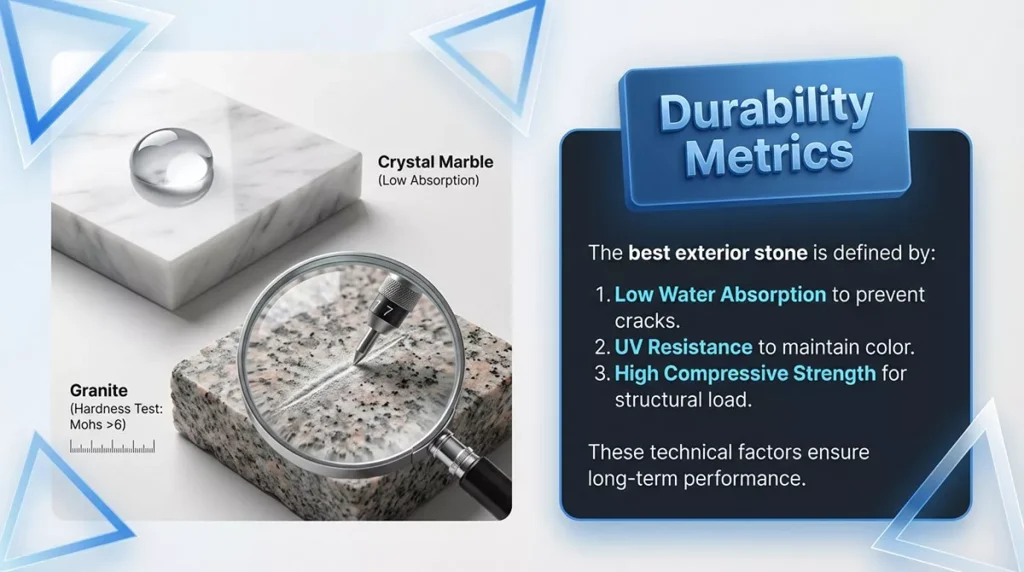
Before analyzing specific stone varieties, it is crucial to understand the technical metrics that define the best stone for exterior walls. A stone that looks magnificent in a showroom may fail catastrophically if it lacks the necessary physical properties for outdoor exposure.
1. Porosity and Water Absorption
Water is the primary enemy of exterior masonry. The water absorption rate indicates how much moisture a stone retains. For exterior use, lower water absorption is generally preferred to prevent damage from the freeze-thaw cycle. However, a slight degree of porosity, as found in Travertine, can actually be beneficial for adhesion to mortar. When evaluating types of stone for exterior walls, one must balance water resistance with adhesion capabilities.
2. Resistance to Environmental Factors
The best stone for exterior walls must possess high resistance to ultraviolet (UV) radiation. Many synthetic materials degrade or change color under constant sun exposure, but high-quality natural stone maintains its hue for decades. Additionally, resistance to acidic environments (acid rain) is vital in urban settings where pollution levels are high.
3. Compressive Strength and Hardness
Exterior cladding must resist physical impacts and the structural load of the building itself (if load-bearing) or its own weight (if used as cladding). Hardness is often measured on the Mohs scale, and high-density stones like Granite and Crystal Marble excel in this category.
4. Thermal Insulation and Energy Efficiency
A robust stone facade for wall systems acts as a thermal mass, absorbing heat during the day and releasing it slowly at night. This contributes to the building’s passive energy efficiency, reducing reliance on HVAC systems. Light-colored stones, such as White Travertine or Crystal, are particularly effective at reflecting solar heat.
Comprehensive Analysis: The Best Types of Stone for Exterior Walls
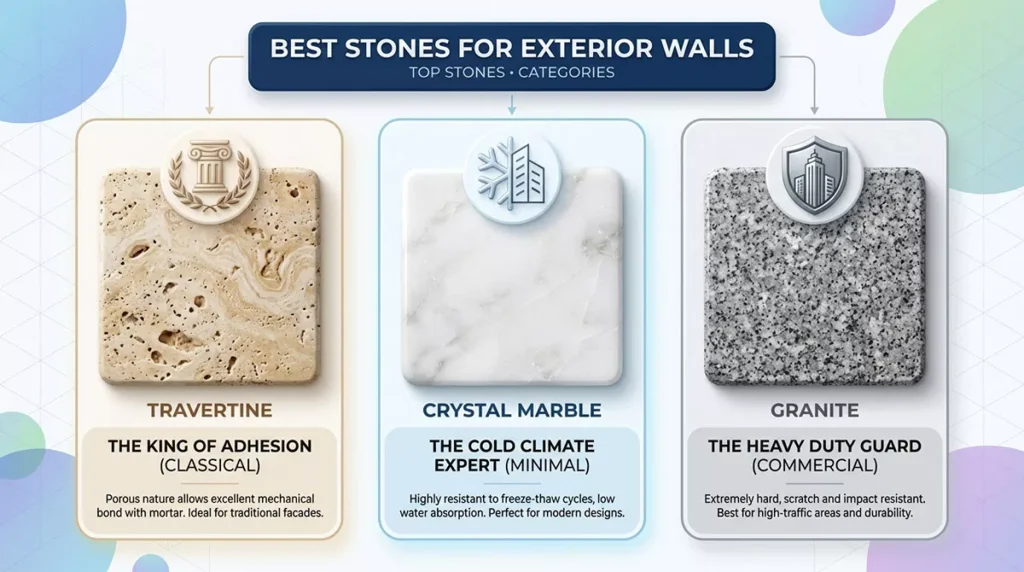
At Pars Stone, we curate specific geological categories that have proven their resilience in diverse climates. Below is an exhaustive analysis of the best stone for exterior walls available in our inventory.
1. Travertine Stone: The Undisputed King of Facades
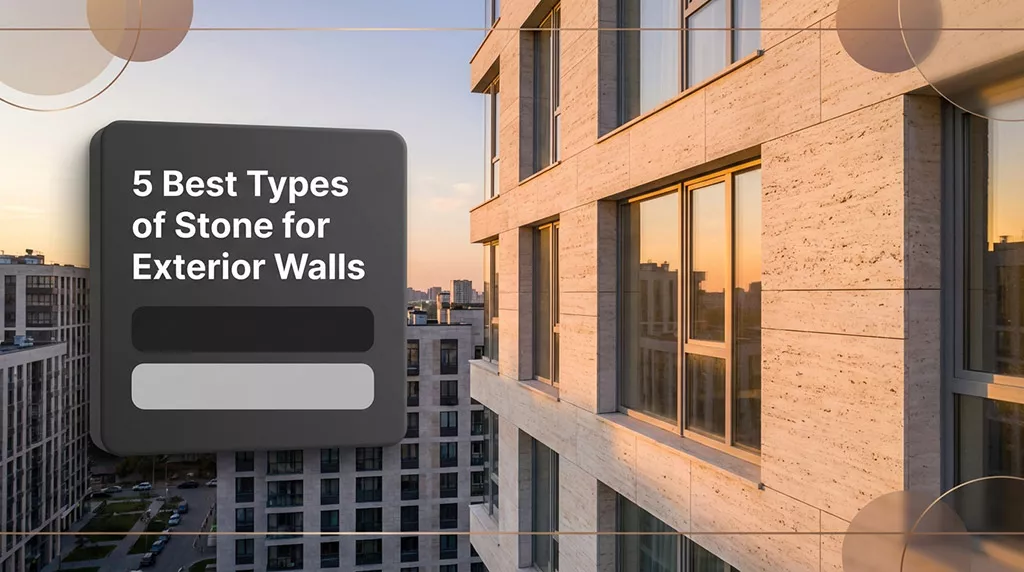
When professionals discuss the best stone for exterior walls, Travertine is frequently the top recommendation. Travertine is a sedimentary rock formed by the precipitation of calcium carbonate in mineral springs. Its unique structure makes it uniquely suited for modern and classical architecture.
Why Travertine is Ideal for Exteriors:
- Adhesion Power: Travertine is characterized by natural surface cavities and pores. When installed using cement mortar, the mortar penetrates these pores, creating a mechanical interlock. This acts like a natural “scope,” significantly reducing the risk of the stone detaching from the facade over time.
- Weight: Compared to Granite or Marble, Travertine has a lower specific gravity, which imposes less dead load on the building’s skeleton.
- Weathering: Travertine is highly resistant to UV rays. Its color does not fade; in fact, many architects believe Travertine ages gracefully, gaining character over decades.
Varieties of Travertine at Pars Stone:
- Cream and White Travertine: These are the most popular types of stone for exterior walls in Roman and Classical facade designs. They reflect sunlight, keeping the building cool.
- Silver and Titanium Travertine: These offer a sleek, modern aesthetic with grey and charcoal tones, perfect for contemporary minimalist designs.
- Red and Lemon Travertine: Used often as decorative accents to create contrast in the facade.
For clients looking to buy stone facade for wall projects that require a blend of luxury and safety, Travertine is the optimal starting point.
2. Crystal Marble (Porcelain/Chini Stone)
Crystal Marble, often referred to as “Chini” stone in the Iranian market, is a metamorphic rock composed of recrystallized calcite. It is distinct from softer interior marbles and is undoubtedly one of the best stone for exterior walls due to its extreme density.
Key Advantages:
- Low Water Absorption: Crystal stone has very low porosity, making it nearly impervious to water penetration. This makes it an excellent choice for regions with heavy rainfall or freezing winters where water expansion could crack softer stones.
- Translucency and Brightness: High-quality Crystal stone has a bright, white crystalline structure that reflects light brilliantly. This luminosity gives buildings a grand, hygienic, and prestigious appearance.
- Durability: It is harder than Travertine and highly resistant to abrasion.
However, due to its low porosity, Crystal stone has less natural adhesion to cement than Travertine. Therefore, when using this stone facade for wall installation, it is mandatory to use “scoping” (mechanical fixation clips) or specialized high-strength adhesives to ensure safety.
3. Granite Stone: The Heavy-Duty Protector
Granite is an igneous rock formed from cooling magma, known for being one of the hardest substances on earth. While its popularity in residential facades has fluctuated due to aesthetic trends, it remains one of the most durable types of stone for exterior walls.
Performance Profile:
- Maximum Hardness: Granite is virtually scratch-proof and impact-resistant. It is ideal for the base courses (plinths) of buildings which are subject to high traffic and physical impact.
- Zero Porosity: Polished granite is non-porous. It does not stain easily and is unaffected by freeze-thaw cycles.
- Industrial Aesthetic: Granite offers a grain structure that suits commercial, industrial, and modern urban buildings.
Like Crystal stone, Granite is heavy and dense. It must be installed using the dry installation method (mechanical bolting) or with robust scoping, as cement mortar does not adhere well to its smooth surface.
Detailed Comparison: Travertine vs. Crystal vs. Granite
To assist you in selecting the best stone for exterior walls, we have compared the three primary contenders based on critical performance metrics.
| Feature | Travertine | Crystal (Porcelain) | Granite |
| Adhesion to Mortar | Excellent (High) | Low (Requires Scope) | Very Low (Requires Dry Install) |
| Water Absorption | Medium | Very Low | Near Zero |
| UV Resistance | High | High | High |
| Color Stability | Excellent | Excellent | Excellent |
| Weight | Medium/Light | Heavy | Very Heavy |
| Best Climate | All Climates | Wet/Cold/Humid | Severe/Industrial |
| Aesthetic Style | Classical & Modern | Modern & Minimal | Commercial/Modern |
Analyzing this table clarifies why Travertine is often cited as the best stone for exterior walls for residential towers, while Granite dominates commercial complexes.
Surface Finishes for Exterior Stone
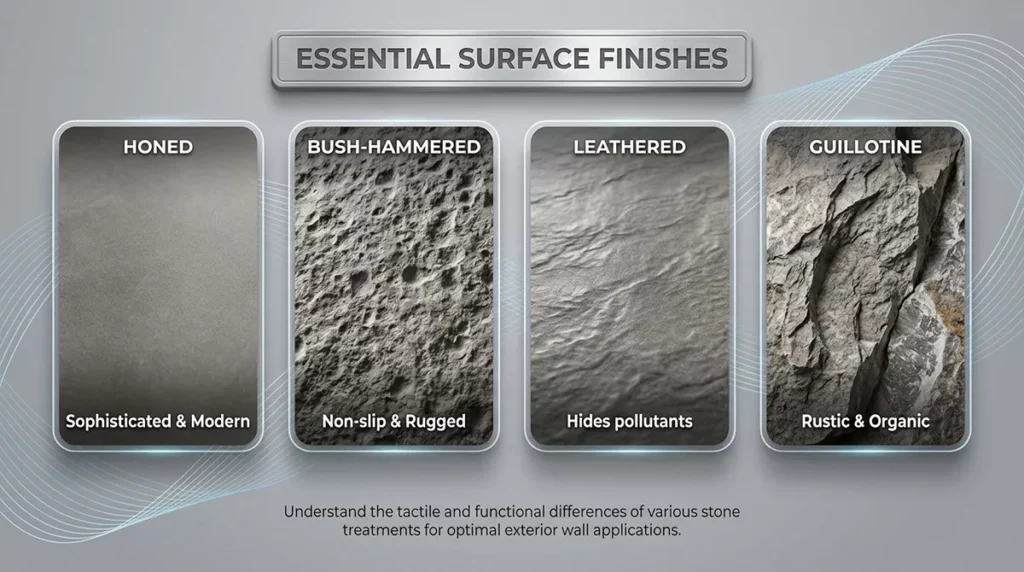
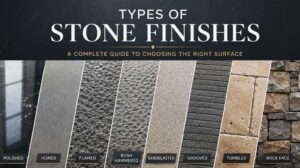
The processing of the stone surface is just as important as the geological type. The finish affects the stone’s color, slip resistance, and durability against weathering. When investigating types of stone for exterior walls, consider the following finishes available at Pars Stone:
- Polished: Creates a reflective, high-gloss surface. It highlights the color and veins of the stone. While beautiful, polished surfaces can be slippery and may show dust more easily.
- Honed (Matte): The stone is ground flat but not polished to a shine. This is increasingly popular for modern stone facade for wall designs, offering a sophisticated, understated look that conceals scratches.
- Bush-Hammered: A textured finish created by striking the stone with a specialized hammer. This adds slip resistance and a rugged, natural aesthetic, often used on the lower levels of a facade.
- Leathered: A texturing process that leaves the stone slightly undulating and smooth to the touch. It is excellent for concealing fingerprints and water spots.
- Guillotine (Split Face): This finish leaves the raw, rough texture of the split rock visible. It is widely used for decorative walls and rustic facades.
Why Iranian Stone is the Global Choice for Exteriors
Iran is recognized globally as a geological paradise, possessing significant reserves of the world’s best stone for exterior walls. The country ranks among the top producers of Travertine, Marble, and Onyx.
Diversity of Quarry:
The sheer variety of quarries in Iran allows for an unmatched spectrum of colors. From the stark whites of Abbasabad Travertine to the rich chocolates of Kashan marble, the options are endless. This diversity ensures that architects can find the exact shade and texture required for their vision.
Cost-Effectiveness:
Due to the abundance of raw material and advanced local processing capabilities, Iranian stone offers an exceptional quality-to-price ratio. International buyers can procure luxury materials that would be prohibitively expensive if sourced from Italy or Spain.
Export Quality Processing:
At Pars Stone, we utilize Italian processing lines to cut, polish, and resin our stones. We ensure that the types of stone for exterior walls we export meet strict European standards for thickness calibration and surface quality. If you wish to source high-grade materials, you can buy stone from Iran directly through our platform, ensuring authenticity and quality control.
Architectural Styles and Stone Selection
The choice of the best stone for exterior walls is deeply intertwined with the architectural language of the project.
The Classical and Roman Facade
This style heavily relies on Cream, Beige, and White Travertines. The porous nature of Travertine mimics the limestone used in ancient Rome. It allows for intricate carvings, columns, and cornices. The visual warmth of beige Travertine creates a sense of luxury and history.
The Modern and Minimalist Facade
Modern architecture favors clean lines, monochromatic palettes, and large-format panels. Here, Silver Travertine, White Crystal Marble, or Black Granite are the preferred types of stone for exterior walls. Architects often use “vein-cut” Travertine to emphasize linearity and height. The “stone facade for wall” in modern design is often ventilated (dry installation) to improve energy efficiency.
The Rustic and Organic Facade
For villas and mountain homes, the best stone for exterior walls is often a Guillotine or split-face finish. This preserves the raw energy of the earth and blends the structure into the natural landscape. Irregular shapes and warm, earthy tones are prioritized here.
Installation Systems: Wet vs. Dry
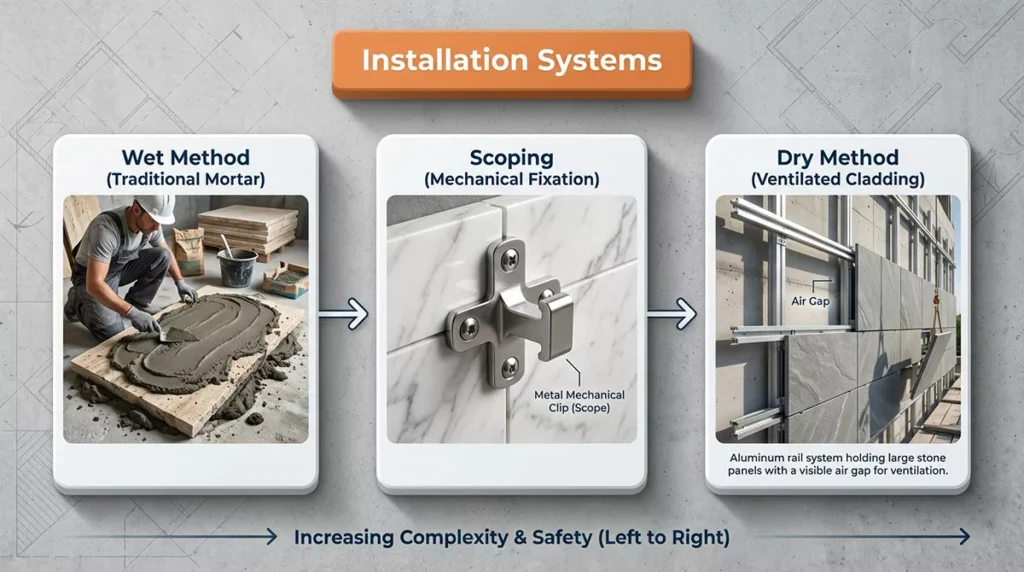
Even the best stone for exterior walls will fail if installed incorrectly. There are two primary methods for cladding:
1. The Wet Method (Mortar)
This is the traditional technique where stone is adhered directly to the backing wall using a cement-sand mortar.
- Pros: Lower cost, suitable for smaller buildings.
- Cons: Susceptible to human error in mixing mortar; risk of detachment in seismic events; slower installation.
- Best Stone: Travertine is the only stone truly safe for this method without scoping, due to its porosity. All other types of stone for exterior walls require mechanical scoping if mortar is used.
2. The Dry Method (Ventilated Facade)
Stones are fixed to a metal substructure (aluminum or steel) using bolts and clips. No mortar is used.
- Pros: Creates an air gap for insulation; rapid installation; easy replacement of damaged panels; zero risk of detachment due to mortar failure.
- Cons: Higher initial cost.
- Best Stone: Granite and Crystal Marble are excellent for this, as are large slabs of Travertine. This is the gold standard for high-rise buildings.
Maintenance and Longevity of Stone Facades
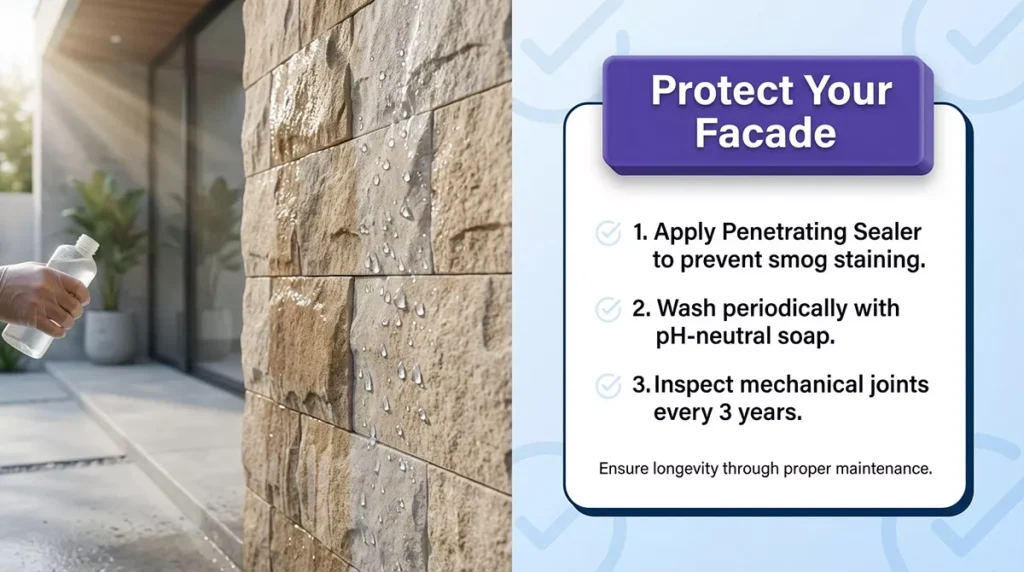
One of the reasons natural stone is the best stone for exterior walls is its low maintenance requirement. However, “low maintenance” does not mean “no maintenance.”
- Sealing: While many stones are durable naturally, applying a penetrating sealer can prevent the absorption of pollutants and water. This is particularly recommended for lighter-colored types of stone for exterior walls in urban environments to prevent smog staining.
- Cleaning: Exterior stone should be washed periodically with water and pH-neutral cleaners. Avoid acidic cleaners on Travertine and Marble, as they can etch the surface.
- Inspection: Every few years, the facade should be inspected for loose grout or sealant failure.
By following these simple steps, a stone facade for wall applications can last for centuries, retaining its value and beauty.
Conclusion
Selecting the best stone for exterior walls is a convergence of art and engineering. It requires balancing the aesthetic vision of the architect with the physical realities of the climate and the structural requirements of the building. Whether you choose the warm, adhesive-friendly Travertine, the pristine and durable Crystal Marble, or the indestructible Granite, natural stone offers a permanence that no synthetic material can replicate.
Understanding the different types of stone for exterior walls empowers you to make an investment that elevates the property’s status and ensures its durability for generations. Pars Stone stands ready to be your partner in this journey, offering the finest collection of Iranian natural stones processed to global standards. We invite you to explore our extensive catalog and discover why so many international developers choose us.
Next Step
Are you ready to transform your building’s exterior with premium natural stone? Buy stone from Iran today by browsing our exclusive collections, or contact our expert consultants for a personalized recommendation tailored to your project’s specific climate and design needs.