Selecting the correct natural stone for an architectural project requires a deep understanding of geological properties and aesthetic variations. Among the myriad options available globally, white marble remains the preeminent choice for creating spaces that convey hygiene, spaciousness, and modern minimalism. However, not all white stones behave similarly under stress or weathering. As a specialized Iranian stone supplier, we recognize that distinguishing between the various types of white marble is crucial for architects and builders. This guide provides a technical overview of Iranian Crystal marble, specifically focusing on the renowned Neyriz and Azna varieties, detailing their structural advantages, processing methods, and functional applications in contemporary construction.
Understanding White Crystal Marble: Beyond Aesthetics
When discussing types of white marble, it is essential to first differentiate between standard sedimentary marble and the metamorphic “Crystal” marble (often referred to scientifically as white marble with a crystalline structure). The products found in the Iranian market, particularly those sourced from the Neyriz and Azna quarries, are technically Crystal Marbles.
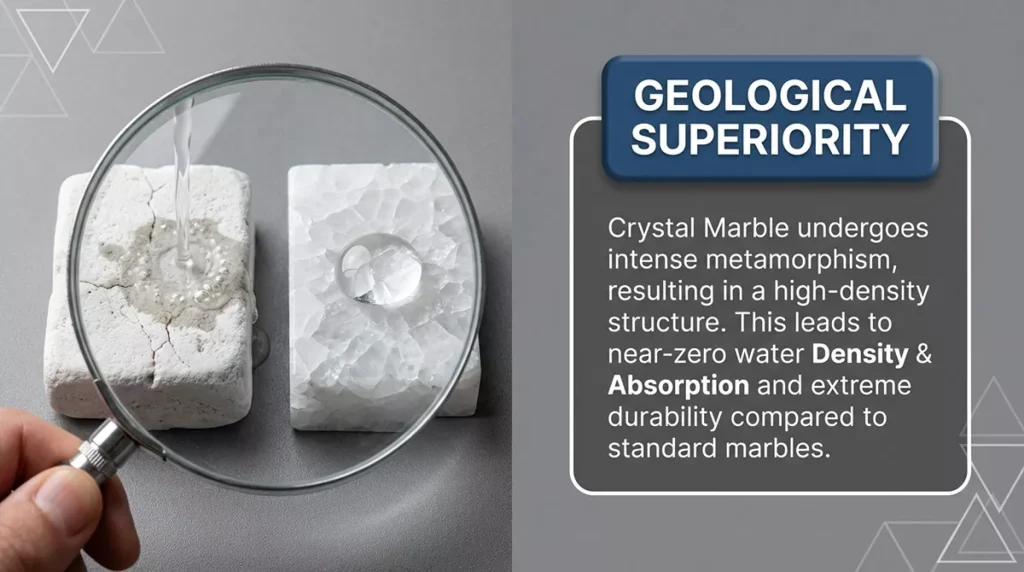
This distinction is vital for commercial and exterior applications. Unlike softer marbles that may absorb water and stain easily, Crystal marble possesses a highly crystallized texture. This results from intense geological pressure and heat over millions of years, creating a stone with:
- Low Water Absorption: Ideally suited for facades and wet areas where moisture penetration causes freeze-thaw damage.
- High Density: Offering superior resistance to abrasion in high-traffic zones.
- Translucency: The crystalline structure allows light to penetrate slightly before reflecting, giving the stone a unique depth and luminosity not found in opaque ceramics.
In the following sections, we will explore the specific white marble types and names available at Pars Stone, categorizing them by their quarry origin and their distinct surface processing.
Neyriz White Marble: The Versatile Foundation

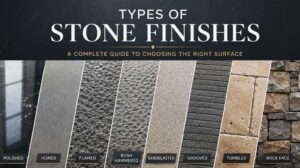
Among the various types of white marble extracted in Iran, Neyriz marble stands out as a benchmark for durability and consistency. Sourced from the Fars province, this stone is characterized by a bright white background featuring subtle, varying patterns of grey or black lines. It is not merely a decorative stone; it is a structural material capable of withstanding harsh environmental conditions.The versatility of Neyriz marble lies in how it reacts to different finishing techniques. While many associate marble only with a polished finish, modern architecture demands textures that offer slip resistance and tactile interest. Below, we detail the specific types of white marble with pictures (visualized through descriptions of their distinct textures) available in our inventory.
1. Sandblasted Neyriz Marble
Sandblasting is a mechanical process where a stream of abrasive material is forcibly propelled against the stone surface under high pressure. When applied to Neyriz marble, this creates a uniform, matte, and slightly rough texture.
- Visual Characteristic: The sandblasting process mutes the sharp contrast of the grey veins, resulting in a whiter, more homogeneous appearance compared to the polished version. The surface loses its gloss but gains a modern, velvet-like visual weight.
- Functional Advantage: The primary benefit is friction. Polished marble is dangerous when wet. Sandblasted Neyriz provides a high coefficient of friction, making it the safest choice for outdoor paving, pool surrounds, and public walkways.
- Architectural Use: This is one of the preferred types of white marble for minimalist facades. The lack of reflection ensures that the building’s form is defined by shadow and light rather than glare.
2. Bush Hammered Neyriz Marble
Bush hammering involves striking the surface of the stone with a specialized masonry tool characterized by pyramidal points. This creates a cratered, pitted surface that is rougher and more organic than sandblasting.
- Texture Profile: The surface feels rugged and historic. It exposes the inner crystal structure of the stone, causing it to sparkle slightly under direct sunlight despite the lack of a chemical polish.
- Durability Factor: This finish is exceptional for high-traffic exterior areas. The rough texture hides scratches, chips, and accumulated dust effectively, reducing the maintenance frequency required for large commercial plazas.
- Design Context: Architects often specify bush hammered Neyriz for plinths (the base of buildings) or retaining walls where a sense of solidity and grounding is required. It contrasts beautifully when placed next to smoother materials like glass or polished metal.
3. Brushed (Leathered) Neyriz Marble
To achieve a brushed finish, the stone is first honed or flamed, and then treated with diamond-tipped rotary brushes. This process removes the softer parts of the stone while leaving the harder crystals intact.
- Tactile Experience: The result is a “leathered” feel—smooth to the touch but with a visible, undulating texture. It is soft underfoot, making it unique among the types of white marble for interior flooring.
- Aesthetic Appeal: This finish enhances the natural color of the Neyriz stone without the artificiality of a high-gloss reflection. It brings out the grey veining in a subtle, sophisticated manner.
- Application: Ideal for interior spaces where slip resistance is needed but a rough, abrasive surface is undesirable, such as bathroom floors, shower trays, and luxury kitchen paving.
4. Grooved and Scratched (CNC) Neyriz Marble
Modern stone processing technology allows for precise mechanical texturing. Grooved (linear lines) and scratched (randomized hatching) finishes are purely decorative treatments applied to Neyriz marble.
- Visual Dynamics: These finishes turn the stone into a feature element. The grooves create a play of light and shadow that changes throughout the day.
- Customization: The depth and pitch (distance) of the grooves can be adjusted. This categorizes it as one of the most customizable white marble types and names for feature walls.
- Strategic Use: Designers frequently use grooved Neyriz for lobby walls, fireplace cladding, or water features. The linear texture can be used to visually elongate a room (horizontal grooves) or heighten a ceiling (vertical grooves).
Azna White Marble: The Iranian Porcelain
While Neyriz is celebrated for its texture and durability, Azna White Crystal marble is revered for its purity and polish. Often compared to international counterparts like Greek Thassos or Vietnamese White, Azna is the premium choice for luxury interiors.
Characteristics of Azna Crystal
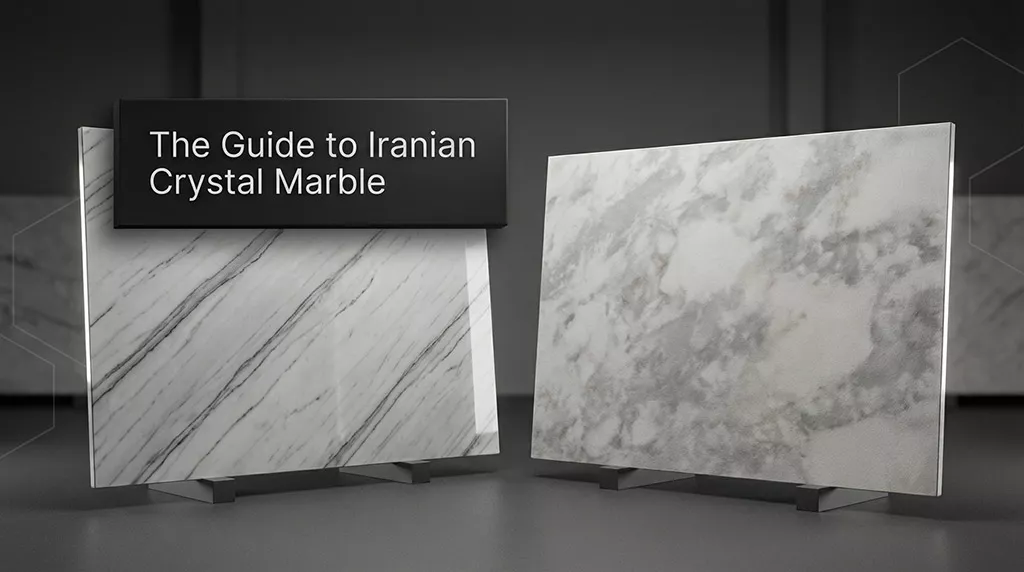
Azna marble presents a porcelain-like white background. Unlike the clouded patterns of Neyriz, Azna typically features distinct, sharp diagonal veins of irregular grey or black. These veins are not defects; they are the stone’s signature.
- Polished Perfection: Azna has minimal porosity, allowing it to take a “mirror polish.” When processed correctly, the reflection quality is superior to almost all other types of white marble.
- Bookmatch Potential: Because of the strong, directional veining, Azna slabs are excellent candidates for book-matching (placing two slabs side-by-side to create a symmetrical Rorschach pattern) or four-matching. This creates a stunning focal point in large lobbies or living rooms.
- Density and Hardness: Despite its delicate appearance, Azna is a crystal marble. It is significantly harder than Italian Carrara, making it less prone to scratching in residential applications.
Ideal Applications for Azna
- luxury Flooring: Large format slabs of Azna white marble create a seamless, expansive look in hotel lobbies and residential halls.
- Countertops: Due to its low water absorption, it is a viable option for vanity tops, provided it is sealed correctly.
- Cladding: Polished Azna is frequently used in interior wall cladding to brighten spaces that lack natural light.
Comparative Analysis: Choosing Between Neyriz and Azna
When browsing our white marble category, clients often ask which stone is “better.” The answer depends entirely on the technical requirements of the project.
| Feature | Neyriz White Marble | Azna White Marble |
| Primary Base Color | White with cloud-like grey undertones | Pure, bright porcelain white |
| Veining Pattern | Subtle, scattered, sometimes spider-web | Sharp, diagonal, distinct grey/black lines |
| Available Finishes | Sandblast, Bush Hammer, Brushed, Polished | Primarily Polished and Honed |
| Best For | Exterior Facades, Paving, High Traffic | Luxury Interiors, Feature Walls, Slabs |
| Slip Resistance | High (in textured finishes) | Low (in polished finish) |
| Price Point | Generally more economical for large areas | Premium pricing for high-end zones |
Both stones fall under the category of Crystal Marble, meaning they share the fundamental benefits of durability and low absorption compared to limestone or travertine. However, for a rough, textured outdoor facade, Neyriz is the superior technical choice. For a high-gloss, opulent interior floor, Azna is the preferred aesthetic choice.
The Importance of Surface Processing in Stone Selection
When researching white marble types and names, one must understand that the name of the stone (e.g., Neyriz) represents only half of the product’s identity. The processing method dictates the color perception and performance.
Why Texturing Matters
In the catalog of types of white marble, a “Sandblasted Neyriz” looks remarkably different from a “Polished Neyriz.”
- Color Shift: Texturing (sandblasting, bush hammering) generally whitens the stone. The micro-abrasions scatter light, making the grey veins appear lighter and the overall surface more uniform. This is crucial for architects seeking a monolithic white facade.
- Maintenance: Polished surfaces show water spots and dust easily. Textured surfaces, specifically bush hammered or brushed, forgive daily wear and tear, making them practical for public commercial spaces.
At Pars Stone, we utilize advanced Italian machinery to ensure that these finishes are consistent across thousands of square meters. This industrial precision distinguishes professional supply chains from small-scale workshops.
Detailed Applications in Contemporary Architecture
To fully appreciate the scope of these materials, we must examine where different types of white marble are currently being installed in modern construction projects.
1. The Modern Facade
The trend in modern facade design has shifted away from composites and back to natural stone. However, the requirement is for durability.
- Recommendation: Sandblasted Neyriz.
- Reasoning: It withstands UV radiation without fading. Unlike polished marble which can dull over time due to acid rain, a sandblasted finish is already matte and retains its appearance for decades. Furthermore, the mechanical adhesion of mortar or dry-fix anchors is superior on the rough back of these stones.
2. The Spa and Wellness Sector
Hygiene and slip resistance are paramount in pools, saunas, and bathrooms.
- Recommendation: Grooved Neyriz or Brushed Neyriz.
- Reasoning: Grooved stone provides physical channels for water drainage and maximum foot grip. Brushed stone offers a soft, pleasant touch for bare feet while preventing slips. The low porosity of Iranian Crystal marble prevents the growth of mold and bacteria within the stone structure.
3. The Corporate Lobby
First impressions in corporate headquarters rely on scale and light.
- Recommendation: Azna White Crystal (Bookmatched slabs).
- Reasoning: The symmetry of bookmatched Azna conveys order and sophistication. The white background reflects artificial lighting, reducing energy costs by brightening the space naturally.
4. Hardscaping and Garden Design
Garden paths require materials that merge with nature but define the space.
- Recommendation: Bush Hammered Neyriz.
- Reasoning: The organic, pitted texture complements greenery and timber. It is immune to damage from garden tools or heavy furniture.
Sourcing and Quality Control: The Pars Stone Standard
Identifying the right types of white marble is only the first step; sourcing them requires a reliable partner. The stone industry is fraught with variations in quality. A “Neyriz” stone from one quarry face may differ significantly in quality from another.
Selection Criteria
We implement a rigorous sorting process. When you view types of white marble with pictures on our site, you are seeing a representation of premium sorting.
- Color Uniformity: We separate blocks based on the background whiteness to ensure that a single project receives a consistent batch.
- Structural Integrity: Blocks with deep fractures or high iron content (which causes yellowing) are rejected before processing.
- Dimensional Precision: Our cutting lines ensure that tiles and slabs are calibrated to exact thicknesses, which is critical for ease of installation.
Export Capabilities
As a leading supplier, we understand the logistics of exporting heavy natural resources. whether the requirement is for slabs, tiles, or cut-to-size dimensional stone, our packaging is designed to withstand maritime transport. We offer these specific white marble types and names directly from the source, eliminating unnecessary middlemen and ensuring competitive pricing for high-quality Iranian stone.
Maintenance and Longevity of White Crystal Marble
A common misconception regarding types of white marble is that they are high maintenance. While this is true for soft Italian limestone, Iranian Crystal marble is remarkably forgiving.
Sealing:
While Neyriz and Azna have low porosity, we recommend applying a penetrating sealer upon installation. This protects the grout lines and the stone from oil-based stains.
Cleaning:
For textured finishes (Sandblasted/Bush Hammered), pressure washing is effective for exterior cleaning. For interior Polished Azna, pH-neutral cleaners should be used. Acidic cleaners (vinegar, lemon) should be avoided as they can etch the calcium carbonate surface, dulling the polish.
Repair:
One of the advantages of natural stone over ceramics is reparability. A scratch on a ceramic tile is permanent. A scratch on Azna marble can be re-polished. A chip on Bush Hammered Neyriz can be smoothed out or left to blend into the rustic texture.
Conclusion
The world of natural stone is vast, but for those seeking durability, luminosity, and timeless beauty, Iranian White Crystal marble is an unparalleled choice. Understanding the nuances between the different types of white marble—specifically the textural ruggedness of Neyriz and the pristine elegance of Azna—allows architects to make informed decisions that enhance both the aesthetics and the longevity of their projects. Whether you require the slip-resistant safety of sandblasted pavers or the luxury of polished slabs, Pars Stone provides a curated selection of these premium materials. We invite you to explore our inventory and Buy stone from Iran directly through our platform, ensuring your project is built on a foundation of quality and authenticity.