
Selecting the best stone for outdoor flooring is a critical architectural decision that bridges the gap between interior luxury and the raw beauty of the natural landscape. Unlike interior design, where aesthetics often reign supreme, outdoor paving requires a rigorous balance of structural integrity, climatic resilience, and safety. Whether curating a serene garden path, a robust driveway, or a lavish pool deck, the material chosen must withstand UV radiation, thermal shock, and heavy foot traffic without compromising its visual allure. As a premier hub for geological diversity, the Iran stone market offers an exceptional range of natural stones processed specifically to meet these demanding exterior standards, ensuring your project achieves both longevity and timeless elegance.
The Philosophy of Exterior Architecture: What Define the “Best” Stone?
When architects and landscape designers search for the best stone for outdoor flooring, they are looking for materials that possess a specific set of physical and chemical properties. The outdoor environment is unforgiving; therefore, the stone must be more than just beautiful—it must be a survivor.
1. Hardness and Abrasion Resistance
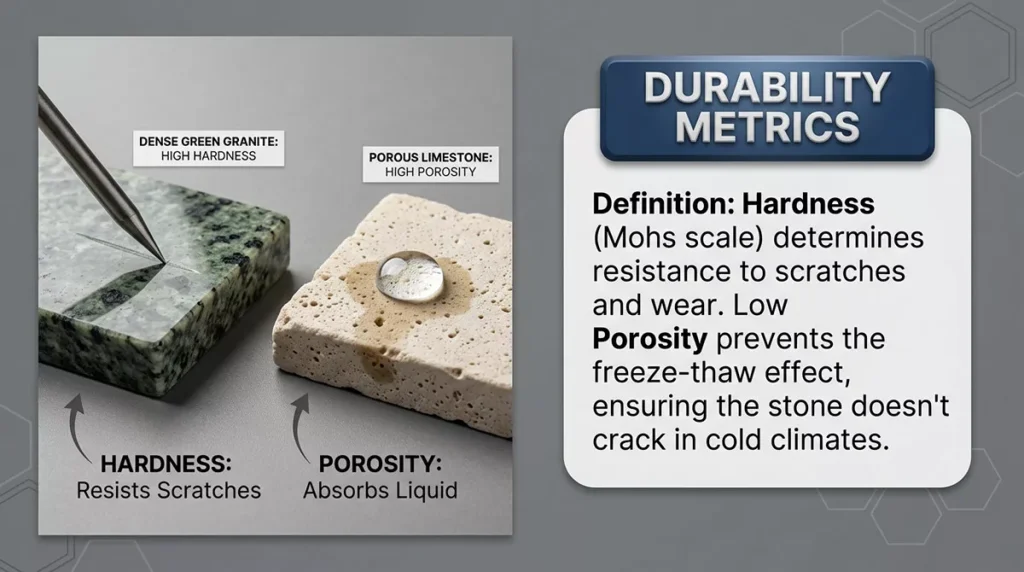
The Mohs scale of mineral hardness is the first metric to consider. Outdoor pavers are subjected to abrasive forces that interior floors rarely encounter—wind-blown sand, garden tools, vehicles, and constant foot traffic. A stone with low abrasion resistance will quickly lose its texture and develop unsightly wear patterns. Granite and Crystal Marble, particularly those sourced from Iranian quarries, are renowned for their high density and resistance to scratching.
2. Porosity and Water Absorption
Perhaps the most critical factor in longevity is water absorption. In climates with freezing winters, stones with high porosity can suffer from the “freeze-thaw” effect. Water enters the pores, freezes, expands, and causes the stone to crack or spall. The best stone for outdoor paving must have low water absorption rates or be properly sealed. Iranian stones like Green Granite and specific processed Crystal Marbles are celebrated for their dense structure, making them nearly impervious to moisture ingress.
3. Slip Resistance (The Safety Factor)
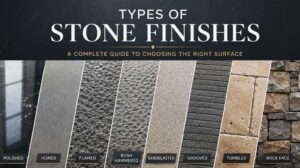
A polished slab of marble is breathtaking in a lobby but a hazard on a rainy patio. For outdoor applications, the surface finish is paramount. The “Coefficient of Friction” must be high enough to prevent slipping when the surface is wet. This is why Pars Stone emphasizes specialized finishes—such as bush-hammered, sandblasted, or grooved textures—which transform naturally smooth stones into safe, non-slip surfaces ideal for wet areas like pool decks.
4. Thermal Stability and UV Resistance
The sun’s ultraviolet rays can bleach pigments in synthetic materials and lower-quality stones over time. Natural stone, however, is formed over millions of years and possesses innate color stability. Furthermore, thermal stability ensures the stone does not warp or crack under rapid temperature changes, a common occurrence in desert or continental climates.
Surface Textures: The Key to Outdoor Performance
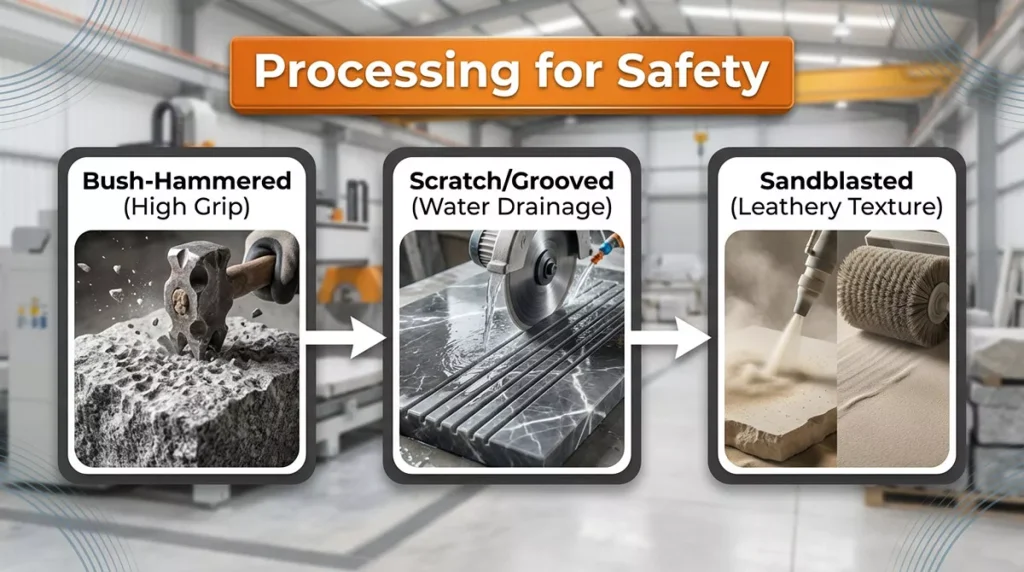
Before analyzing specific stone types, it is vital to understand that the “best” stone is often defined by its finish. At Pars Stone, we utilize advanced processing technologies to alter the surface of stones like Marble and Pietra Grey, making them suitable for exterior use.
The Bush-Hammered Finish
This technique involves using a specialized tool to impact the stone’s surface, creating a pitted, rough texture. This not only enhances the stone’s slip resistance significantly but also lightens its color, giving it a weathered, antique appearance. Bush-hammered Crystal Marble is a top contender for the best stone for outdoor flooring because it combines the durability of marble with a high-grip surface.
- Explore Options: Brushed Bush Hammer Stones
The Scratch (Grooved) Finish
For modern architectural lines, a scratch or grooved finish is superior. This involves cutting linear grooves into the stone. Aside from the striking visual texture, these grooves channel water away from the surface, making it an excellent choice for wet climates and pool surrounds.
- Explore Options: Scratch Finish Stone
The Sandblasted and Brushed Finish
Sandblasting erodes the softest parts of the stone, creating a fine, granular texture. When followed by brushing, the sharp edges are softened, resulting in a surface that feels like leather—pleasant to walk on barefoot yet grippy enough to be safe.
The Elite Selection: Top Stones for Outdoor Paving

Based on geological properties and architectural performance, here are the top recommendations from the Pars Stone inventory.
1. Green Granite: The Unyielding Titan
When durability is the non-negotiable priority, Green Granite stands unrivaled as the best stone for outdoor paving. Sourced from the rich mineral belts of Iran (specifically Birjand), this stone is geologically classified as one of the hardest natural materials available.
Why it represents the best stone for outdoor flooring:
- Zero-Compromise Durability: Granite is resistant to acids, scratches, and impact. It creates a driveway or patio that will likely outlast the building itself.
- Aesthetic Harmony: The deep forest greens and subtle mineral veining allow this stone to blend seamlessly with garden foliage. It does not compete with nature; it enhances it.
- Maintenance: It requires virtually no maintenance. It does not stain easily and hides dust and debris effectively.
For high-traffic commercial plazas or driveway paving, Green Granite with a flamed or bush-hammered finish provides the ultimate peace of mind.
- View Collection: Green Granite Collection
2. Crystal Marble: The Misunderstood Masterpiece
There is a misconception that marble is solely for interiors. While this is true for polished soft marbles, Crystal Marble (such as Neyriz or Azna White) is structurally different. It is a metamorphic rock with a high degree of crystallization, making it harder and more durable than typical sedimentary limestones.
Optimizing Crystal Marble for Outdoors:
The secret lies in the processing. When we apply a Bush-hammered or Scrubbed finish to Crystal Marble, it becomes one of the best stone for outdoor flooring options available.
- Thermal Comfort: White Crystal Marble reflects sunlight, staying cool to the touch even in scorching summers. This makes it the premier choice for pool copings and sunbathing areas.
- Visual Brilliance: The crystalline structure sparkles under the sun, providing a sense of luxury that concrete or pavers simply cannot replicate.
- Durability: With a textured finish, it resists scratches and provides excellent grip.
By choosing a textured White Crystal Marble, you achieve a “resort-style” aesthetic without sacrificing safety.
- View Collection: White Marble & Crystal
3. Pietra Grey Marble (Lashotor): The Modern Icon
For contemporary architecture that favors minimalism, monochromatic palettes, and industrial chic, Pietra Grey (Lashotor) is the definitive choice.
The Architectural Edge:
While Pietra Grey is famous for polished interior slabs, its outdoor variations—specifically Bush-hammered or Grooved—are rapidly becoming the industry standard for modern luxury landscaping.
- Contrast: The dark charcoal grey (which turns a lighter, sophisticated grey when bush-hammered) provides a stunning contrast against green grass, blue pool water, and white architectural elements.
- Hardness: Lashotor stone has low water absorption compared to other limestones, making it suitable for exterior cladding and paving in various climates.
- Versatility: It can be used for stairs, facade cladding, and floor paving, allowing for a unified design language from the vertical to the horizontal plane.
If you are looking for the best stone for outdoor flooring that speaks the language of modern design, textured Pietra Grey is the answer.
- View Collection: Pietra Grey Marble
4. Travertine: The Classic Outdoor Companion
Travertine has been used since the Roman era, and for good reason. Its natural formation in hot springs gives it a unique porosity that brings distinct advantages to outdoor living spaces.
Why Travertine Endures:
- Heat Resistance: Like Crystal Marble, light-colored Travertine (Cream or Silver) does not absorb excessive heat. It remains comfortable for barefoot walking in high summer.
- Natural Texture: Even without heavy processing, the natural voids (if left unfilled or properly finished) provide a degree of slip resistance.
- Aesthetic Warmth: The beige, cream, and silver tones of Travertine bring a warm, rustic, and inviting atmosphere to patios and courtyards.
Comparative Analysis: Granite vs. Marble vs. Travertine
To assist in your decision-making process for the best stone for outdoor paving, consider this comparative breakdown:
| Feature | Green Granite | Textured Crystal Marble | Textured Pietra Grey | Travertine |
| Hardness | Extreme (7-8 Mohs) | High (3-4 Mohs) | High (3-4 Mohs) | Medium (3 Mohs) |
| Porosity | Very Low | Low | Low | Medium-High |
| Best Use | Driveways, Heavy Traffic | Pool Decks, Luxury Patios | Modern Gardens, Paths | Patios, Pool Coping |
| Aesthetic | Nature-focused, Dark | Bright, Luxurious | Modern, Industrial | Rustic, Warm |
| Maintenance | Low | Medium | Medium | Medium |
Installation Best Practices for Long-Term Success
Even the best stone for outdoor flooring will fail if installed incorrectly. To ensure the longevity of your investment, consider these professional installation guidelines.
1. The Sub-Base is Crucial
The stone is only as stable as the ground beneath it. A proper sub-base consisting of compacted gravel and sand (or a concrete slab) is essential to prevent settling. In areas with heavy rainfall, proper drainage gradients must be calculated to prevent water pooling on the stone surface.
2. Thickness Matters
For outdoor use, the standard 1.5cm or 2cm thickness used indoors is often insufficient, especially for driveways. We recommend using stones with a thickness of at least 3cm to 4cm for paving applications. Thicker stones have higher flexural strength and are less likely to crack under load or ground movement.
3. Sealing and Protection
While Iranian stones are durable, applying a high-quality penetrating sealer is recommended, particularly for lighter stones like Crystal Marble and Travertine. A sealer prevents organic stains (from leaves or soil) and oil stains (from BBQ grills or vehicles) from penetrating the stone’s pores, maintaining its pristine appearance for years.
Why Source from Pars Stone?
The global stone market is flooded with options, but sourcing directly from Iran offers distinct advantages. Iran is a geological paradise, ranking among the top countries globally for the diversity and volume of its stone reserves.
The “Laboratory of Design and Texture”
Pars Stone is not merely a supplier; we are innovators in stone processing. We understand that the best stone for outdoor paving requires more than just quarrying—it requires engineering. Our facility specializes in creating unique textures (Scratch, Bush-hammer, Leather) that enhance the stone’s performance.
Direct Sourcing
By choosing to buy stone from Iran through Pars Stone, you eliminate multiple layers of intermediaries. This ensures that you receive premium grade material—sorted meticulously for color and quality—at a competitive price point. We control the supply chain from the block extraction to the final texture processing, ensuring that the stone arriving at your project site meets the highest international standards.
Design Trends 2026: Outdoor Living
Current design trends are moving away from the “perfectly polished” look towards organic luxury. The best stone for outdoor flooring in modern design is one that feels authentic.
1. The “Indoor-Outdoor” Flow: Architects are using the same stone inside and outside to blur the boundaries. For example, using Honed Pietra Grey inside and transitioning to Bush-hammered Pietra Grey outside. This creates a visual continuum while adhering to safety requirements.
2. Large Format Pavers: Small cobbles are being replaced by large rectangular slabs (e.g., 40x80cm or 60x120cm). Large formats reduce the number of grout lines, creating a cleaner, more expansive look that makes small gardens appear larger.
3. Mixed Textures: A growing trend involves mixing finishes of the same stone. Imagine a patio of brushed Green Granite bordered by a strip of deeply grooved Green Granite. This subtle play on texture adds sophistication without introducing clashing colors.
Conclusion
Choosing the best stone for outdoor flooring is an investment in the functionality and value of your property. It requires navigating the technical trade-offs between aesthetics, grip, and durability. Whether you are captivated by the invincible nature of Green Granite, the cool luxury of textured Crystal Marble, or the modern silhouette of Pietra Grey, Pars Stone offers a curated selection processed specifically for exterior rigor. We invite you to explore our specialized textures and discover how Iranian stone can transform your outdoor landscape into a masterpiece of endurance and style. For those ready to elevate their project, we encourage you to buy stone for outdoor flooring directly from the experts who understand the soul of the stone.